The 5G standardization is enabling new capabilities from the enhanced connectivity with Gbps throughput, <5ms latency, and capacity for thousands of end devices. With the expansion of spectrum into the millimeter wave (mmWave) spectrum, Gigahertz of bandwidth is now available to boost capacity. The 5G New Radio (NR) Frequency Range 2 (FR2) from 24GHz to 60GHz can meet the growing network demand but at the expense of shorter cell range due to higher path loss. Massive MIMO with 64, 128, or 256 transmit and receive elements relies on high-gain beamforming to steer the coverage directly to user equipment, effectively extend coverage to hundreds of meters.
To provide adequate 5G coverage over significant distances requires multiple 5G NR massive MIMO radios. This represents a massive investment in infrastructure and the high power consumption elevates operational expenses. Operators are discovering that the economics of mmWave need to change in order to scale it to regions outside of downtown cores and other high-density zones. Network repeaters are serving to solve this issue by extending the range of the network at a fraction of the cost of a base station deployment. Their small size, low power consumption, and no fiber line means zoning and permission is streamlined and ongoing OPEX and time to deployment can be streamlined.
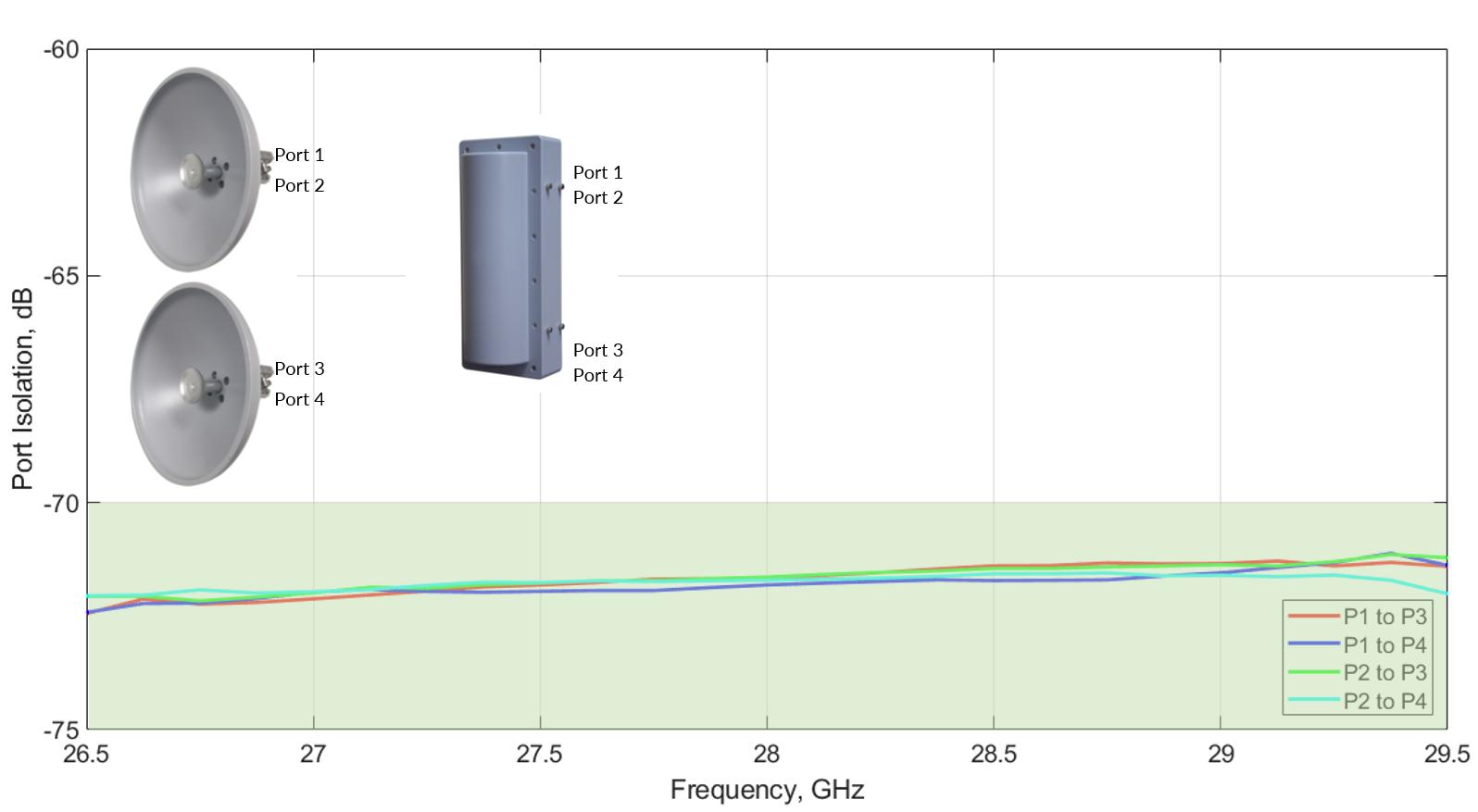
At its most basic form, a network repeaters consist of a receiving donor antenna, low noise amplifiers, and a transmitting antenna. The donor antenna is a point-to-point (PtP) antenna used to transmit uplink and receive downlink back to the GnB. The server antenna is a point-to-multipoint (PtMP) antenna used to transmit downlink and receive uplink from the UE. The total gain the repeater provides is dependent on each antenna’s individual gain and the amplifiers gain. To reach peak gain requires all feedback loops be suppressed and isolation between donor and server antenna and uplink and downlink paths is critical for success.
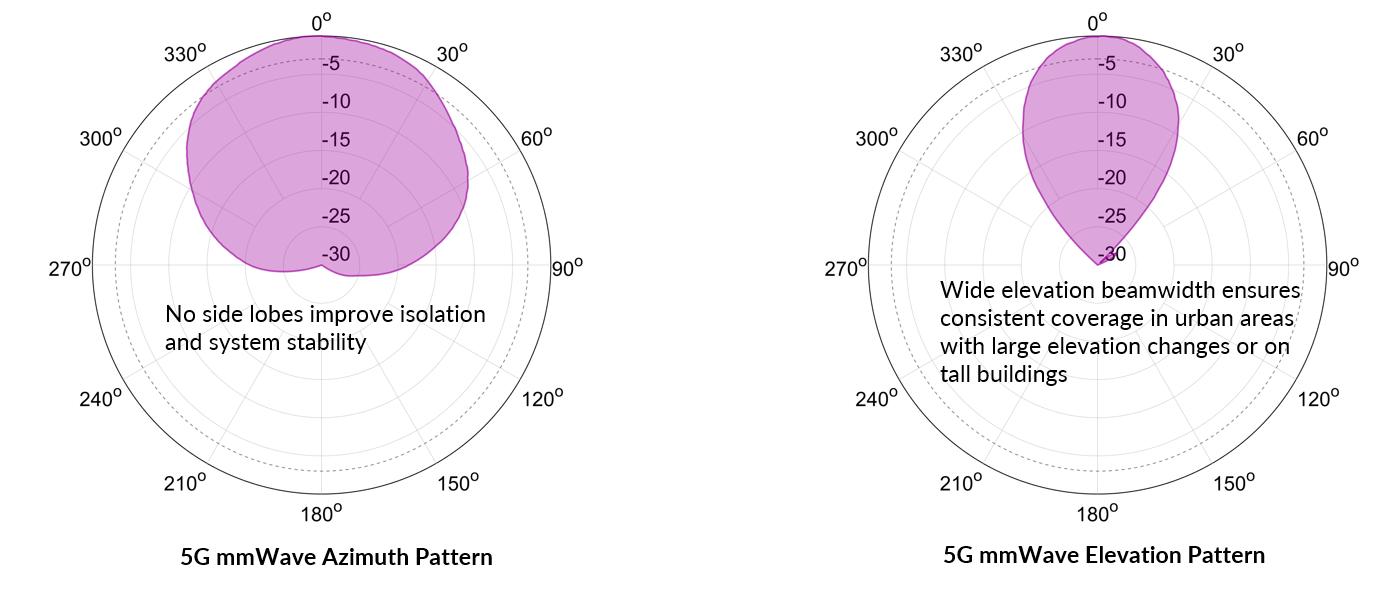
LinQ Antenna specializes in designing high-efficiency mmWave antennas that are optimized for 5GmmWave repeater and base station applications. Our 5G antennas uses advanced waveguide technology with high-precision manufacturing to expertly craft the radiation pattern of the antenna with side lobes suppressed into the noise floor. In combination with low-loss protective materials and a nearly lossless metallic waveguides, the antennas can offer the highest gain in the prescribed form factor and provide ultra-high isolation. The donor antenna builds upon parabolic technology and incorporates a OMT to offer dual polarization that is adjustable between slant and Horizontal/Vertical orientations. Taking a modular approach, the system can be adapted to full-duplex 2x2 MIMO using two closely spaced parabolic antennas. The server antenna uses waveguide sector arrays to deliver a pattern that is optimized for repeater application, typically with a wide 45-65 degree azimuth 3dB beamwidth and moderate 15-25 degree 3dB elevation beamwidth. The exclusion of any PCBs and lossy materials maximize antenna efficiency beyond that in the GnB’s massive MIMO arrays. When used in combination, the LinQ donor and server antenna can provide up to 70dB of isolation between uplink and downlink, allowing an equal boost to the gain of the repeated signal. The repeater system with passive antennas and low-power consumption can now offset the higher power consumption of the active antennas in the GnB, augmenting the network to extend cell range down and overcome line-of-site obstacles.
The unlicensed wifi bands has allowed billions of users to be stay connected with friends and family and now has a strong foundation in the 2.4GHz and 5GHz frequency bands. WiFi 6 and 6E under the IEEE 802.11ax standard promises improved efficiencies and better management of the frequency spectrum. More use cases are taking advantage of the 3-fold improvement in overall throughput and ultra-low latency afforded from the higher spectral efficiency. Operators of the Wifi 6E technology are primed to make use of the expanded 6GHz band and now can make use of the entire U-NII radio band from 5.15GHz to 7.125GHz. The ultrawide bandwidth, orthogonal frequency-division multiple access (OFDMA), and multi-user multiple-input multiple-output (MU-MIMO), are driving strict RF requirements on the antenna to reach maximum down and up-link throughput.
The antenna must drive higher spectral efficiency through accurately focusing the radios power into the intended region and suppressing all radiation outside of it. LinQ antenna careful controls the antenna’s horizontal and elevation pattern, engineering the 3dB and 10dB beamwidths to maximize coverage and minimize self interference. For macro- and rural applications, the LinQ high-gain sector antenna with suppressed elevation side lobes, sharp pattern roll off, and over 35dB front to back allows for reuse of channels in the cell and increase cell edge distance. In high-density applications and sub-urban zones, horn antennas will reduce interference by sharply tapering the radiation outside the main beam with side lobes even more suppressed. Using a combination of sector and horn antennas will allow operators to achieve maximum functionality out of their radios. LinQ antenna offers access point antenna solutions for Wifi 6E and are designed to have stable performance over the ultra-wide bandwidth.
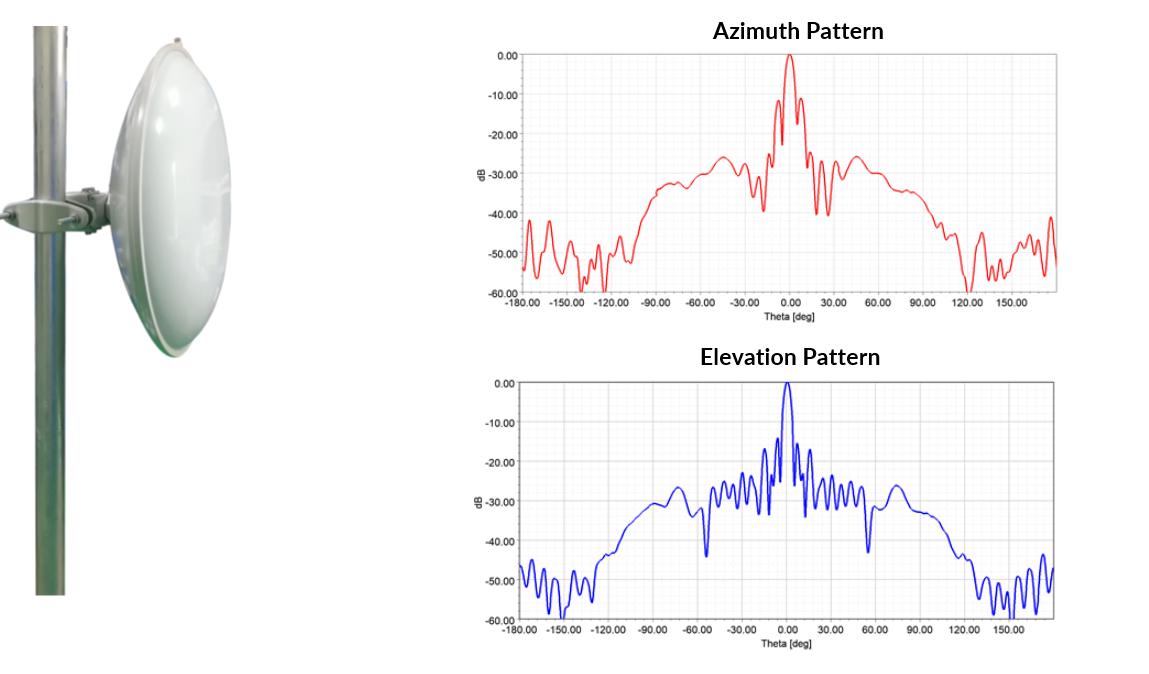
Parabolic antennas offer an effective tool to improve link budget through increasing overall CPE gain and reducing outside noise. They are poised to be the go-to-solution for Wifi 6E which has strict requirements on interference and frequency management with the shared access and lightly-licensed spectrum. Parabolic antennas feature side lobes reduced to be in the noise floor and that outperform equivalent sized flat panel antennas. The use of lossless waveguide technology and high precision parabolic surface ensures maximum antenna efficiency that cannot be beat using conventional PCB technology. This leads to further improvement in gain, allowing operators to improve throughput to the customer and ultimately provide a better connectivity experience.
LinQ antenna works with customers to understand their networks topography and ecosystems unique requirements to recommend, design, and deliver customized WiFi 6E access point and client premise antenna solutions.
Whether it is fixed wireless access or private networks, both address the need to provide reliable, secure and cost-effective connectivity to residential and enterprise users. No two networks are the same and LinQ Antenna has the experience and extensive portfolio of point-to-point (PtP) and point-to-multipoint (PtMP) antenna solutions for fixed wireless client-premise, backhaul, and access point applications.
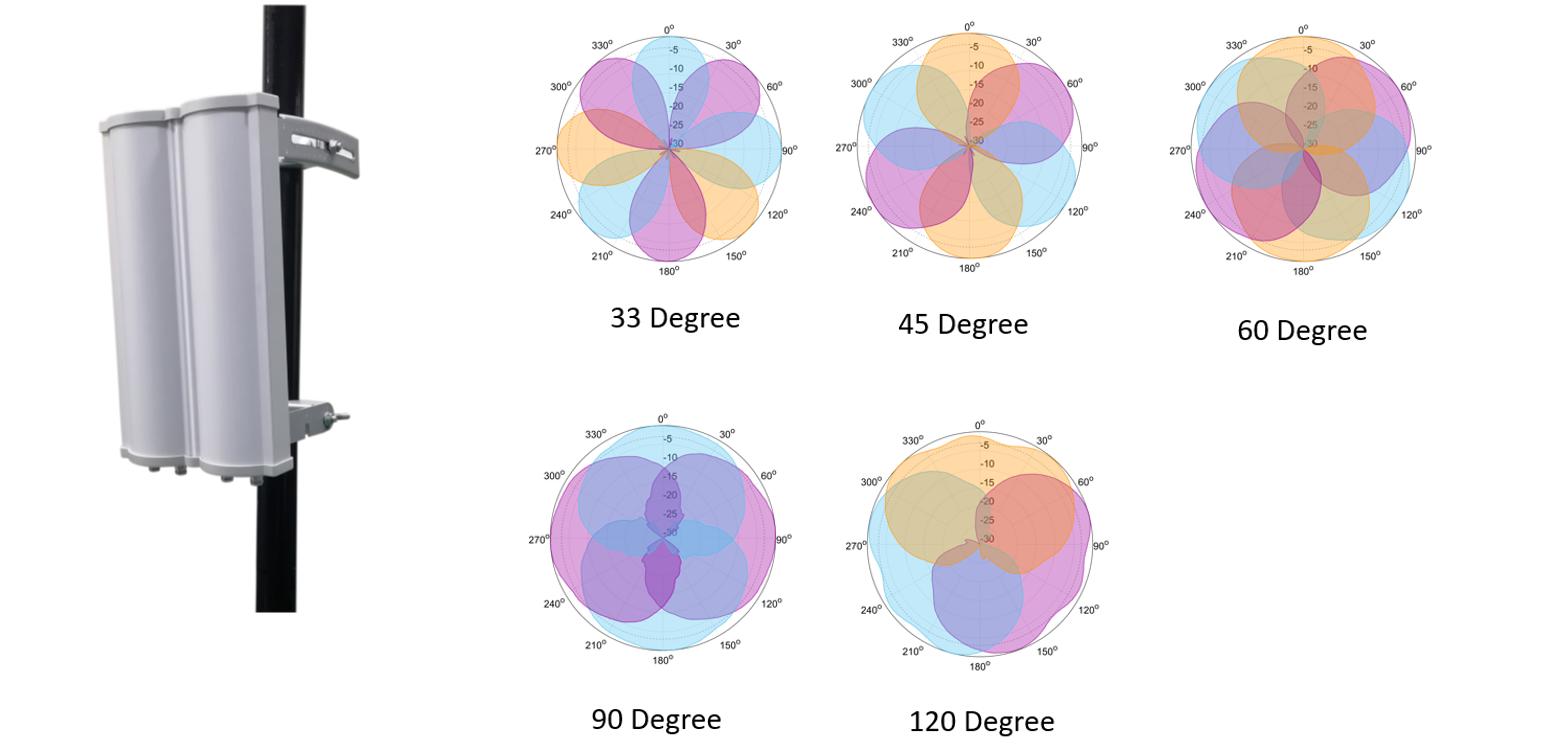
The network’s requirements and topography will dictate the antenna deployment in PtMP which can be optimized for cost, capacity, and coverage. In low-density or gap-filling scenarios requiring 360-degrees of coverage, an omnidirectional antenna with a minimal azimuth pattern ripple and high gain allows operators to achieve maximum coverage with minimal investment. By ensuring the azimuth pattern has no nulls, coverage is guaranteed irrespective of direction around the tower. A healthy balance between antenna gain and elevation beamwidth is needed to eliminate null zones and ensure coverage is consistent inside the entire cell. If higher gain is needed, a directional antenna is needed like sector or horn antennas. Sector antenna’s wide azimuth beamwidth and narrowed elevation beamwidth provides maximum antenna gain is received in a region. Stable null fill can also be applied for uniform coverage close to the tower. A highly focused main beam, sharp azimuth pattern roll offs, and no side lobes are critical to reduce signal creep into other sectors and minimize self-interference. This allows channel reuse with multiple sectors operating at peak QAM due to the improvement in signal to noise ratio. Various azimuth beamwidth options from 33-degrees to 120-degrees allows operators to choose how wide and far coverage should extend. LinQ antenna can advise you on what is the optimal antenna pattern for the network application and supply antennas that support the radio to meet its full potential and help networks exceed their KPIs.
With wireless technologies standardizing on 4x4 MIMO and with the recently introduced multi-user and massive MIMO, pattern degradation, isolation, and correlation starts to become a real issue as you pack more technology into a single package. LinQ antennas has multi-band and UWB RF to mmWave technologies that allow for the highest functionality with minimalist form factor. Our antennas will provide consistent RF responses, irrespective of the port, with overlapping azimuth and elevation patterns. With a reliable antenna platform, RF planners can build networks with confidence that field results will match simulations.
Size, cost, gain, and the radiation pattern envelope are the key parameters in choosing the correct PtP antennas for the last-mile connectivity and backhaul. Parabolic antennas are a key tool in controlling radiation and interference and improving link budget. LinQ parabolic antennas are a reliable antenna platform that incorporates high-quality and nearly-lossless materials with durable surface coatings built to survive the elements. Advanced waveguide, orthomode transducer, and sub-reflector technology maximizes the port isolation and return loss across ultra-wide bandwidths and enable perfect coupling to the parabolic. High precision manufacturing enables a precise and consistent parabolic shape that is optimized to provide the theoretical maximum gain with almost non-existent side lobes. This reduces noise in networks and improve link budget, boosting overall throughput and extending cell range. Operators are able to quickly return the investment through faster data packages and more clients per access point.
Utilities and coops providers need to provide always-on customer service and, at the same time, track distribution and perform real-time monitoring. Obsolete communications infrastructure is forcing service providers to find harmonized communication technology to improve capacity and reliability for more devices but without unnecessary complication. A combination of public and private networks will be the method for utilities to update advanced meter reading (AMR) applications, introduced fixed wireless services, improve remote monitoring capabilities and increase security. The go-to radio technology has not settled yet, although early adopters are looking at a combination of LTE, 5G, WiFi and outdoor DAS to fill the role. LinQ Antennas has the antennas you need and the experience to deliver high quality antennas that are the lowest total cost of ownership.

Service operators need to ensure that they’re using the right type of antennas. The antenna plays a critical role in ensuring strong and reliable connectivity. High gain and efficiency and reliable and sturdy mechanical platforms and pattern integrity are key in ensuring a successful connection year after year. LinQ Antennas can help advise and deliver on the correct antenna choice that is built to match the long service life of infrastructure in utility application.
Today, providers can leverage the 900MHz ISM and Anterix (896-901/935-940MHz), unlicensed WiFi and WiFi 6E (2.4GHz, 5GHz, and 6GHz) and 3.5 GHz Citizens Broadband Radio Service (CBRS) to enable services. LinQ Antennas designs a range of antennas that deliver reliable, secure, high-grade performance for utility networks.
Wireless technology has empowered public safety crews, first responders, and critical infrastructure by staying connected, improving response times and overall community safety. Our purpose-built antennas enable broadband public safety connectivity and mission critical LMR for applications in P25, TETRA, LTE, FirstNet, and 5G networks.

|
First responders need reliable radio coverage to stay safe during an emergency which necessitates robust antenna and radio equipment that can operate without failure in the harshest environments. LinQ antenna specializes in highly-reliably and durable mechanical platforms that enable successful broadband deployments for mission critical applications.
High performance multi-band antennas that are interoperable with LMR and broadband networks allow effectively coordination between different agencies and improves response time. Our specialized antennas improve intelligence, safety and operational efficiency and can ensure reliable video streaming in the field for in-vehicle video and surveillance systems.
|
|
Corporate Office 116 8th Street South, Unit 200, Lethbridge, Alberta, T1J 2J3. |
| E-mail: info@linqtech.ca |